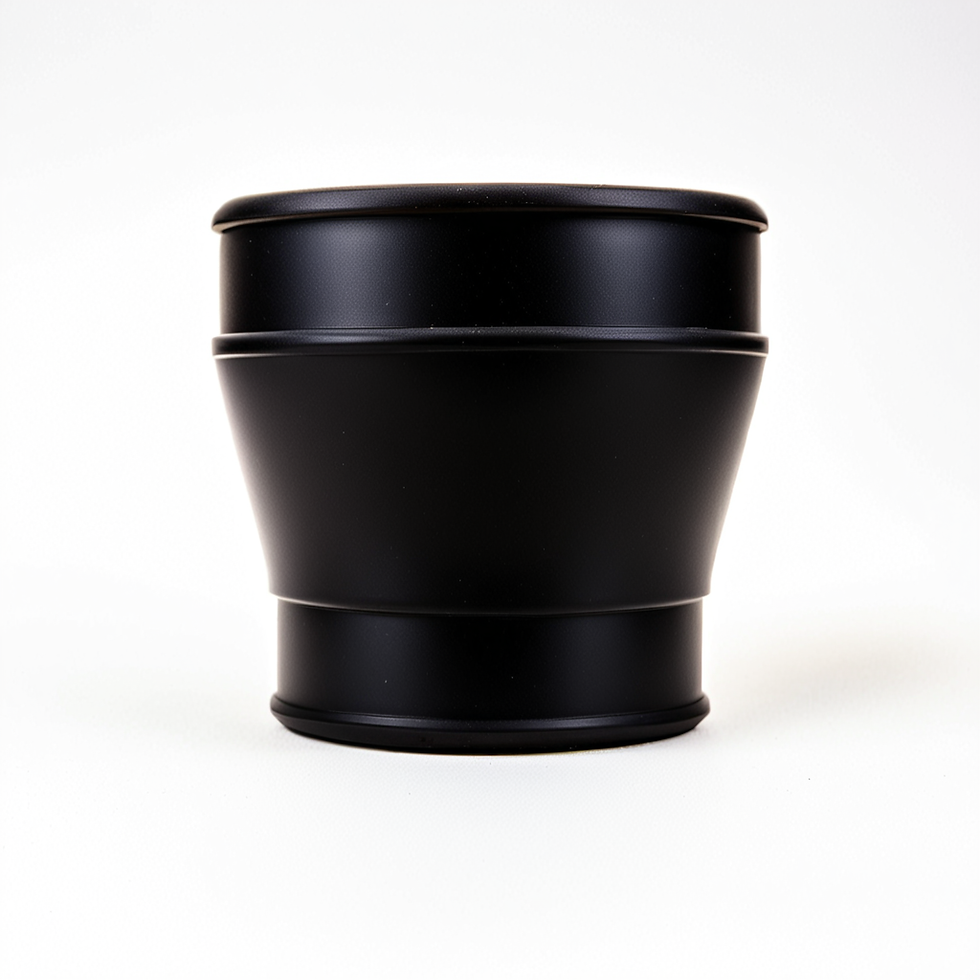
The 250mm to 150mm (6") adapter is a heavy-duty, large-bore commercial reducer designed for high-capacity extraction systems. This fitting is engineered to bridge the gap between massive-diameter appliances or trunk outlets (250mm) and standard global 6-inch (150mm) infrastructure.
Whether you are managing large-scale commercial range hoods, industrial process ventilation, or centralized HVAC manifolds, this adapter provides the structural integrity required for high-volume airflow.
📐 Engineering & Geometry
Because of the massive 100mm diameter differential, this adapter features a unique, "near-flat saucer" geometry. Unlike the conical transitions found elsewhere in our catalog, this design is a structural necessity to manage the extreme transition scale.
Uniform Structural Integrity: A consistent 4mm wall thickness is maintained from the 250mm rim all the way to the 150mm outlet.
Maximum Load Capacity: Features dual integrated hose clamp grooves. The 250mm rim carries the largest circumference in the DT3D catalog, engineered to handle maximum tension and sustained airflow pressure.
Bidirectional Utility: Optimized for use as a 250→→150mm reducer or a 150→→250mm increaser.
✅ Key Specifications
Extreme Transition: 100mm diameter step (the largest in the series).
Precision Wall Thickness: 4mm uniform thickness (no thinning through the flare).
Standard Compatibility: 150mm / 6" outlet for seamless integration with global fan and duct standards.
Print Efficiency: Support-free design; oriented for optimal layer adhesion.
🔧 Primary Applications
Commercial Kitchens: Large canopy/range hood extraction to 6" building ducts.
Industrial Ventilation: Process outlets to standard extraction infrastructure.
HVAC & Grow Ops: Large-bore plenum/trunk distribution to 6" branch networks.
Marine/Industrial: Heavy-duty ventilation trunk-to-port transitions.
🖨️ Critical Print Protocol
Warning: This is the most structurally demanding print in the DT3D catalog.
To ensure the functional success of this part, you must adhere to the following parameters:
Material: ASA ONLY. The structural loads and thermal requirements of commercial extraction demand the dimensional stability of ASA. Do not use PLA+ or PETG for functional applications.
Orientation: Large-end down (250mm base on plate). This is the only viable orientation. The 25able 250mm rim cannot be bridged and must be built upward from the plate.
Wall Thickness: 8 to 10 Walls (Minimum). Because the geometry is constantly changing, infill is structurally inefficient here. High wall counts provide the necessary strength through the flare.
Infill: 0% Infill.
Layer Height: 0.2mm.
Top/Bottom Layers: 5–6 layers.